
Here is a detailed overview of the types of portable gas sensors, presented in the format of an academic paper for clarity and depth.
A Comprehensive Overview of Portable Gas Sensor Technologies
Abstract
The development and proliferation of portable gas sensors have become increasingly critical in ensuring safety, health, and environmental monitoring across various sectors. These devices leverage a range of sensing technologies, each with distinct operating principles, advantages, and limitations, tailored to detect specific classes of gases.
This paper provides a comprehensive overview of the primary types of portable gas sensors, including Electrochemical, Catalytic Combustion, Semiconductor Metal-Oxide (MOS), Infrared (IR), and Photoionization Detector (PID) sensors.
It delves into the fundamental mechanisms behind each technology, their typical applications, key performance characteristics, and inherent challenges. Furthermore, the discussion extends to the critical aspects of sensor selection, emerging trends, and the future trajectory of portable gas sensing technology, providing a holistic understanding of the field.
1. Introduction
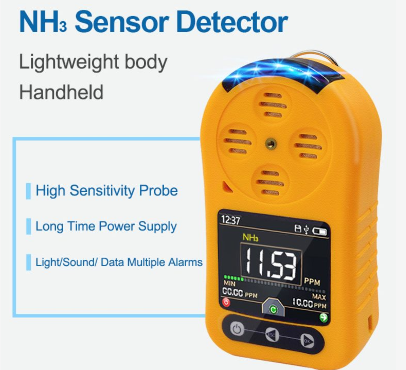
Portable gas sensors are self-contained, compact instruments designed to detect and measure the concentration of specific gases in the environment. Their importance is paramount in numerous applications, from safeguarding workers in industrial settings to monitoring air quality in urban areas.
The core of any portable gas detector is its sensor—a transducer that converts the chemical information of a target gas into an analyzable electrical signal. The evolution of these sensors has been driven by the need for higher sensitivity, selectivity, stability, miniaturization, and power efficiency. Unlike fixed gas detection systems that are installed in specific locations for continuous monitoring, portable devices offer the flexibility for personal exposure monitoring, leak hunting, confined space entry testing, and emergency response.
The choice of sensor technology is primarily dictated by the target gas, the required sensitivity, the operational environment, and cost constraints. This review systematically examines the major sensor technologies that empower these vital portable devices.
2. Fundamental Types of Portable Gas Sensors
2.1. Electrochemical Sensors
Electrochemical sensors are predominantly used for the detection of toxic gases, such as Carbon Monoxide (CO), Hydrogen Sulfide (H₂S), Nitrogen Oxides (NO, NO₂), Chlorine (Cl₂), and Oxygen (O₂) . They are renowned for their high sensitivity to low concentrations of gases, making them ideal for personal safety applications where exposure limits are in the parts-per-million (ppm) range.

2.2. Catalytic Combustion (Catalytic Bead) Sensors
Catalytic combustion sensors are the workhorses for detecting and measuring combustible gases and vapors, such as methane, propane, and hydrogen, within their Lower Explosive Limit (LEL) . They are a staple in industrial safety for preventing explosions.
2.3. Semiconductor Metal-Oxide (MOS) Sensors
Semiconductor metal-oxide sensors, often called "chemiresistors," are versatile sensors used for detecting a broad spectrum of gases, including combustible gases like methane, toxic gases like CO, and volatile organic compounds (VOCs) .
2.4. Infrared (IR) Sensors
Non-Dispersive Infrared (NDIR) sensors are highly effective for detecting gases that exhibit characteristic absorption bands in the infrared region, such as Carbon Dioxide (CO₂), methane (CH₄), and many other hydrocarbons .
- Operating Principle: NDIR sensors work on the principle of infrared absorption spectroscopy. The sensor contains an infrared light source, a sample chamber (or an open path), an optical filter, and an infrared detector. The IR light is emitted through the sample gas. Specific gas molecules absorb IR energy at unique wavelengths. The optical filter is selected to allow only the wavelength that is strongly absorbed by the target gas to reach the detector. The detector measures the intensity of the received IR light. The concentration of the target gas is determined by the degree of attenuation of the IR beam, following the Beer-Lambert law .
- Advantages: They offer exceptional selectivity for their target gas, as the absorption spectra are like molecular fingerprints. They are not susceptible to poisoning, sensor degradation, or oxygen deprivation, making them very stable and long-lasting. They do not consume the sensor element and can operate in inert atmospheres.
- Disadvantages and Challenges: They are generally more expensive and complex than other sensor types. They can be larger in size and have higher power consumption. They are less effective for detecting diatomic molecules (like O₂, N₂, H₂) and homonuclear molecules (like Cl₂), which do not have a permanent dipole moment and thus lack strong IR absorption features.
2.5. Photoionization Detectors (PID)
Photoionization Detectors are the tool of choice for measuring low levels (ppm to ppb) of a wide range of Volatile Organic Compounds (VOCs) and some toxic gases.
- Operating Principle: A PID uses high-energy ultraviolet (UV) light to ionize gas molecules. The lamp inside the sensor emits photons with a specific energy, measured in electronvolts (eV). Common lamp energies are 9.8 eV, 10.6 eV, and 11.7 eV. If the ionization energy (IE) of a gas molecule is less than the energy of the UV photons, the molecule will be ionized, losing an electron and becoming a positively charged ion. These ions are attracted to an electrode, creating a current. The magnitude of this current is proportional to the concentration of the ionizable gas present .
- Advantages: PIDs provide extremely high sensitivity to a broad spectrum of VOCs, offer a fast response time (seconds), and do not consume the sensor. They are invaluable for leak detection, indoor air quality assessments, and hazardous waste site investigations.
- Disadvantages and Challenges: They lack specificity; a PID cannot distinguish between different types of VOCs, as it responds to all compounds with an ionization potential below the lamp's energy. The measurement can also be influenced by humidity. Furthermore, they cannot detect compounds with a higher ionization energy than their UV lamp (e.g., methane, formaldehyde with a 10.6 eV lamp).
3. Comparative Analysis and Selection Criteria
Selecting the appropriate portable gas sensor technology requires a careful balance of performance requirements and practical constraints. The following comparative analysis outlines the key differentiators.
- Sensitivity and Detection Range: Electrochemical sensors are ideal for low-level (ppm) toxic gas detection. Catalytic sensors are designed for percent-of-LEL ranges for combustibles. PIDs excel at detecting ppb to ppm levels of VOCs, while NDIR and MOS sensors can be configured for both trace and percent-level detection depending on the application.
- Selectivity: NDIR sensors offer the best selectivity for specific gases with distinct IR spectra. Electrochemical sensors can be engineered for good selectivity, but cross-sensitivity can occur. PIDs and MOS sensors have broad, non-specific responses, making them "broad-spectrum" detectors rather than gas identifiers without additional data analysis (e.g., using sensor arrays and pattern recognition algorithms).
- Power Consumption: Electrochemical sensors are the most power-efficient, as they do not require heating. This is a critical advantage for wearable, always-on portable devices. MOS and catalytic sensors require significant power to heat their elements, and NDIR sensors also consume more power due to the IR source. PID power consumption depends on the UV lamp.
- Lifespan and Durability: NDIR and PID sensors have the longest operational lives, as they are non-consumptive technologies; their components can last for many years. Electrochemical sensors have a typical service life of 2-3 years. Catalytic beads can last several years but are vulnerable to poisoning. MOS sensors have a long life but suffer from baseline drift.
- Cost: Semiconductor (MOS) sensors are the most cost-effective, followed by catalytic bead and electrochemical sensors. NDIR and PID technologies are generally the most expensive due to their optical and complex electronic components.
4. Applications of Portable Gas Sensors
The application landscape for portable gas sensors is vast and diverse, underscoring their societal importance.
- Industrial Safety and Occupational Health: This is a primary application area. Workers in oil and gas, chemical plants, utilities, and mining carry portable multi-gas detectors, often equipped with a combination of electrochemical sensors for O₂, CO, and H₂S, and a catalytic bead sensor for LEL combustibles, to protect against asphyxiation, poisoning, and explosions .
- Environmental Monitoring: Environmental agencies and consultants use portable PIDs and IR sensors to survey and monitor VOC levels in ambient air, soil vapor, and water, track greenhouse gas emissions like methane, and identify pollutant plumes .
- Emergency Response and Hazardous Materials (HazMat): First responders rely on portable, rugged multi-gas meters and PIDs to quickly identify unknown chemical threats, assess the scope of a gas leak, and make life-saving decisions during chemical spills or fires.
- Confined Space Entry: Testing the atmosphere of tanks, silos, manholes, and other confined spaces is a mandatory safety procedure before entry. Portable gas detectors are used to ensure oxygen levels are safe and that toxic and flammable gases are not present .
- Leak Detection: Maintenance technicians use portable sensors, particularly PIDs for VOC leaks and specialized NDIR sensors for refrigerant or methane leaks, to pinpoint the source of fugitive emissions in industrial pipework and valves.
5. Emerging Trends and Future Outlook
The field of portable gas sensing is dynamic, with several promising trends shaping its future.
- Miniaturization and MEMS Technology: The use of Micro-Electro-Mechanical Systems (MEMS) is revolutionizing sensor design. MEMS technology allows for the fabrication of microscale sensors, such as tiny MOS and IR sensors, on silicon chips . This leads to dramatic reductions in size, weight, power consumption, and ultimately, cost, while enabling large-scale production.
- Sensor Fusion and Multi-Gas Capabilities: There is a growing trend towards integrating multiple different sensor technologies into a single portable device. A modern portable detector might house electrochemical, catalytic, PID, and MOS sensors simultaneously, providing a more comprehensive picture of the gas hazards present . Advanced data fusion algorithms can interpret the signals from this "electronic nose" to improve accuracy and identification.
- Internet of Things (IoT) and Connectivity: The integration of wireless communication technologies (e.g., Bluetooth, Wi-Fi, LoRaWAN) into portable gas detectors is creating a connected ecosystem . This allows for real-time data transmission to central control rooms, cloud platforms for big data analytics, and live location tracking of workers, enabling faster emergency response and proactive safety management.
- Advanced Materials and Improved Selectivity: Research into novel sensing materials, such as graphene, carbon nanotubes, metal-organic frameworks (MOFs), and nanostructured metal oxides, holds the promise of developing next-generation sensors with unprecedented sensitivity, lower operating temperatures, and enhanced selectivity, overcoming many of the limitations of current technologies.
6. Conclusion
Portable gas sensors are indispensable tools for ensuring safety, health, and environmental protection. The diversity of available technologies—Electrochemical, Catalytic Combustion, Semiconductor Metal-Oxide, Infrared, and Photoionization Detectors—ensures that there is a suitable sensing solution for nearly every conceivable gas detection challenge. Each technology operates on a unique physical or chemical principle, resulting in a distinct profile of strengths and weaknesses related to sensitivity, selectivity, cost, and power needs. The selection of a sensor is therefore a critical, application-dependent decision. As technology advances, driven by trends in miniaturization (MEMS), connectivity (IoT), and novel materials, portable gas sensors are poised to become even more sensitive, intelligent, reliable, and integrated into our digital world, further enhancing their role in safeguarding lives and the environment.